
Past purchases and commercial activity provide the historical foundation for evaluating current customer behavior.

Pika 360 brings the customer's transaction history, calculated value indicators, behavioral context, communication reachability and open opportunities together within a single customer perspective.
The objective is not simply to display more customer data. It is to bring different Pika contexts together around one question: What is the customer's current situation?

Pika 360 is the Pika layer that brings a single customer's transaction history, calculated customer value, behavioral context, communication reachability and open opportunities into the same decision perspective.
Pika 360 does not create a new version of customer truth. It brings context calculated by analytical layers such as Customer Intelligence together with customer transactions and opportunity information in a customer view that users can evaluate.
That means Pika 360 goes beyond answering: “Who is this customer?”
The product role of Pika 360 is to turn customer data from a profile into unified context that supports decision making.
A name, phone number, email address and basic profile details tell you who the customer is.
They do not explain the customer's current commercial situation by themselves.
Transaction history is one context.
Purchase rhythm and behavioral change are another.
Customer value is another.
Communication reachability and open opportunities are additional parts of the decision.
When those signals remain fragmented, users must mentally reconstruct customer context before making a decision.
The purpose of Pika 360 is not:
To display more customer data.
It is: To bring the customer context required for a decision into the same perspective.

Pika 360 brings different types of information into the same customer perspective. Each context answers a different question.
Past purchases and commercial activity provide the historical foundation for evaluating current customer behavior.

Value indicators produced by Customer Intelligence help evaluate the customer's commercial importance through historical behavior rather than one isolated transaction.
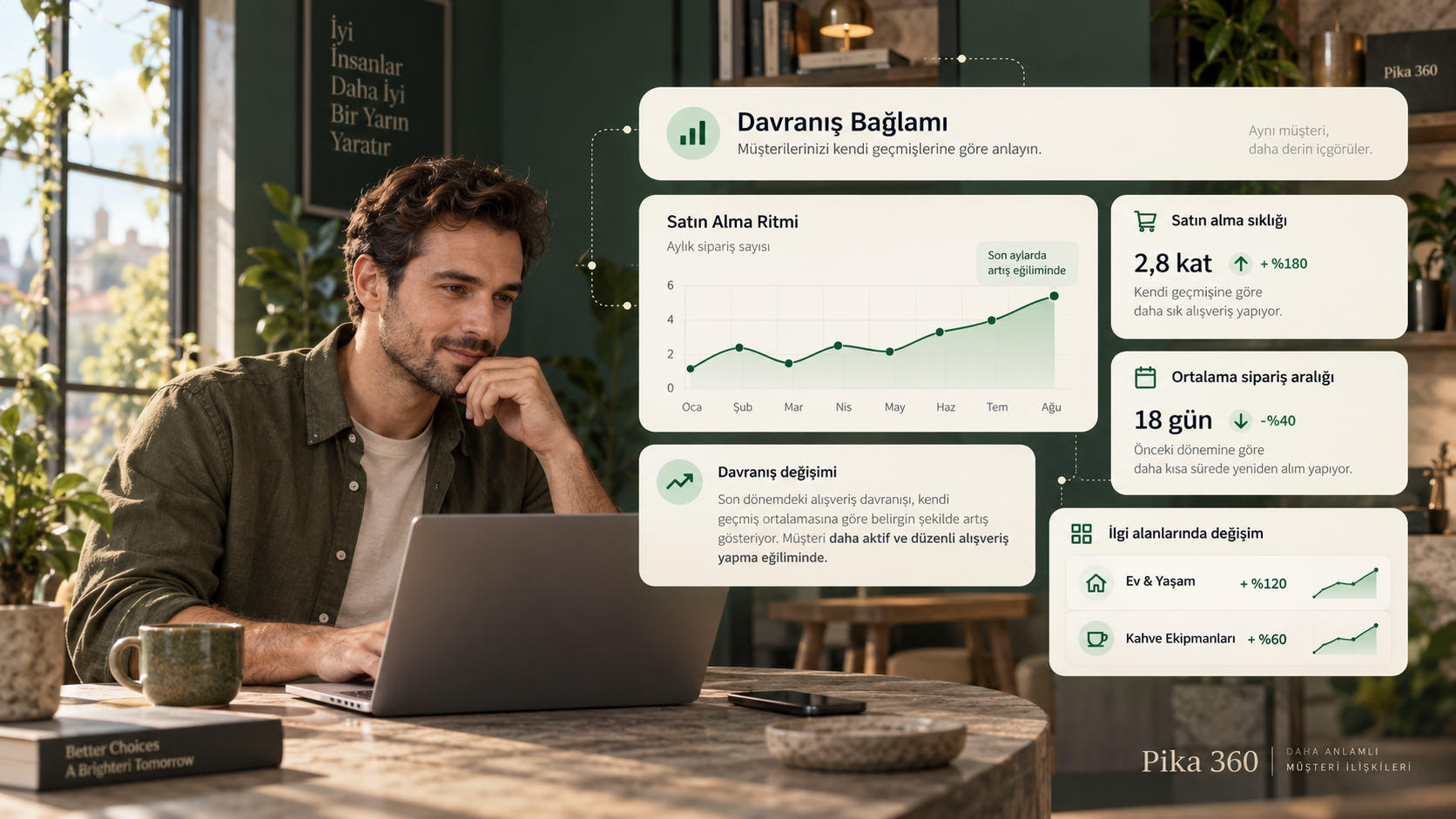
Calculated signals such as purchase frequency, rhythm and behavioral change help reveal how the customer is changing relative to their own history.

Available reachability and permission context for communication channels can form part of the decision perspective when evaluating possible action.

Evaluable commercial opportunities associated with the customer can be considered alongside historical and behavioral context within the same customer perspective.
Conceptual illustration · sample data
None of these elements is the decision by itself.
The value of Pika 360 is bringing these pieces into customer context that a user can evaluate together.
A traditional customer view often presents identity information and historical records. That information matters, but it does not always provide enough context for a commercial decision.
The distinction of Pika 360 is that it helps users evaluate historical records together with current calculated customer context and open opportunities.
The user does not only look at the past. They can also evaluate what that past means now.
Customer Intelligence and Pika 360 do not play the same product role. Customer Intelligence produces calculable signals such as customer value, purchase rhythm and behavioral change from transaction and behavioral history.
Pika 360 brings that calculated customer context together with other customer information such as transaction history, communication reachability and open opportunities within the same decision perspective.
Customer Intelligence produces analytical context.
Pika 360 is the customer-level decision perspective where that context can be evaluated.
Daily Opportunities makes evaluable commercial opportunities such as repeat purchase, cross-sell and win-back visible from customer and product context.
Pika 360 helps place those opportunities within the single-customer perspective.
The opportunity is no longer only an action candidate in a list.
It can be evaluated together with the customer's transaction history, value and behavioral context.
Opportunity: “What could be done?”
Pika 360: “What does this opportunity mean within this customer's complete context?”
Pika 360 is not the engine that calculates the opportunity. It makes the open opportunity part of the customer's decision perspective.
Commercial opportunity and communication availability are different concepts.
A meaningful opportunity may exist for a customer, but communication reachability and permission context must also be considered when evaluating possible action.
Pika 360 can make available communication-reachability context visible as part of the customer perspective.
This does not change the opportunity itself. It gives the user important control context when evaluating the next step.
Pika 360 is not a delivery engine.
Its role is to: Keep customer context visible before a decision is made.
Pika 360 does not replace Campaign Manager or Journey Manager.
Those tools manage campaign and journey processes.
The role of Pika 360 is to bring together the context required for a customer-level decision.
Once a decision to communicate is made, audience, campaign, journey or other controlled action processes are managed by the relevant Pika layers.
Pika 360 is not a delivery screen.
It exists to help users see the customer in the right context before action.
A significant part of the customer context evaluated in Pika 360 comes from transaction data and Pika's calculation layers.
AI may help explain or summarize existing customer context more quickly.
Customer value, purchase rhythm, behavioral signals and open opportunities are not treated as information invented by generative AI.
Customer context comes first.
AI can help make that context easier to understand.
The final decision remains with the user.
Different intelligence and opportunity layers in Pika perform different roles.
Produces behavioral, purchase-rhythm and calculated customer-value context.
Customer Intelligence →Establishes product meaning within customer need and commercial relationships.
Product Intelligence →Makes evaluable commercial opportunities visible from customer and product context.
Daily Opportunities →Brings the customer-relevant parts of those contexts together with transaction history and communication reachability within a single customer decision perspective.
After a decision is made, audience and controlled marketing action are managed in the relevant product layers.
The distinctive role of Pika 360 is not to become another analytical engine. It is to make different Pika contexts evaluable at the individual-customer level.
CRM systems may manage customer records and operational relationship processes. The primary role of Pika 360 is not to store the customer record, but to bring customer decision context created in Pika into one perspective.
Customer Intelligence produces calculations and analytical context about customer behavior. Pika 360 makes those results visible together with other customer contexts.
Daily Opportunities is the opportunity layer that surfaces evaluable commercial opportunities. Pika 360 helps evaluate open opportunities alongside the customer's other contexts.
Pika 360 is a decision perspective. Campaign, journey and channel execution are managed by the relevant action layers in Pika.
Core customer context comes from transaction data and calculated Pika signals. AI may help explain or summarize that context; it is not the source of customer truth.
Customer 360 commonly refers to unifying customer data from different sources into one profile. Pika 360 goes further by evaluating calculated customer intelligence and open opportunities within decision context.
Let's explore how Pika 360 brings transaction history, calculated customer value, behavioral context, communication reachability and open opportunities together within one customer perspective.
Pricing is tailored to your requirements and scope of use.